
Last updated November 16, 2026
 Wrought iron
 Wood & steel frame
 Farm & ranch
 Sliding driveway gates
 LiftMaster operators
Free on-site gate assessment - hinges, posts, and your LiftMaster or Nice gate operator checked before anything is quoted
The assessment is free and the quote is the invoice.
Get your free estimateDIY vs Professional Gate Repair: The Glendale Homeowner’s Decision Guide
Most DIY gate repair advice skips the part that actually matters: the legal line, not just the skill line. Replacing a remote battery is a homeowner task. Adjusting a limit switch on a low-voltage operator can be a homeowner task with the right knowledge. Opening a control board enclosure on a 120V line-connected operator is a task that requires an Arizona ROC license to perform legally, no matter how handy you are. That distinction drives everything in this guide.
What follows is a clear framework for Glendale homeowners: how to tell a mechanical fault from an electrical one, what the Regis
stry of Contractors rules actually say about scope of work, which tools real diagnostics require, and the repairs that look simple on video but tend to fail here. You’ll finish knowing exactly which jobs are yours to take on and which ones to hand to a licensed specialist.
Quick Answer
In Glendale, AR, mechanical gate repairs (hinges, rollers, latches, tracks, physical alignment) are generally homeowner-permissible, but anything touching line-voltage wiring, the control board on a 120V operator, or the motor’s electrical components legally requires an Arizona ROC-licensed contractor. The practical rule: if the fault is mechanical and the gate is unpowered, DIY is a reasonable option. If the fault is electrical, involves the operator, or the gate is a heavy automated system, call a licensed specialist. Gate Repair Glendale offers free estimates and can tell you in a short phone call which category your problem falls into.
Styles & brands we work with
- Wrought iron
- Wood & steel frame
- Farm & ranch
- Sliding driveway gates
- LiftMaster operators
Table of Contents
- The Mechanical vs. Electrical Fault Split
- Arizona ROC Rules: What’s Legal to DIY in Glendale
- Tools and Diagnostic Equipment Real Repair Requires
- Warranty and Insurance: The Hidden Costs of DIY
- Five Repairs That Look Simple but Fail in Glendale
- Why Glendale’s Caliche and Heat Change the Math
- Brand-Specific Considerations: LiftMaster, FAAC, Mighty Mule, Elite
- A Step-by-Step Decision Framework
The Mechanical vs. Electrical Fault Split
The single most useful thing you can do before deciding whether to DIY is classify your fault. Every gate problem is either mechanical or electrical, and the two categories have very different risk profiles, tool requirements, and legal implications.
Mechanical faults involve the physical structure of the gate: hinges, rollers, wheels, tracks, chains, latches, stops, posts, and panels. These are the parts that move or hold the gate in place. A sagging gate, a dragging roller, a chain that jumped the sprocket, a latch that won’t catch – all mechanical. They’re visible, they’re usually within arm’s reach, and the gate can be manually locked open or closed while you work.
Electrical faults involve the operator: the motor, the control board, the wiring, the photo-eye sensors, the loop detectors, the keypad, and the power supply. Symptoms of an electrical fault include:
- The gate won’t move at all when you press the remote, but the manual release works fine.
- The gate moves in one direction only.
- The gate reverses unexpectedly mid-travel.
- The operator clicks or hums but doesn’t move the gate.
- The gate stops partway and needs a reset.
- Sensors behave erratically or the operator beeps continuously.
A fault that appears in only one direction, or that comes and goes with temperature, is almost always electrical. A fault that’s visible when you look at the gate (a bent hinge, a worn roller, a misaligned track) is almost always mechanical. When symptoms are mixed, the electrical side takes priority because the safety systems on an automated gate depend on it. This is where electric gate repair becomes the relevant service rather than general mechanical work. If your gate is manual and unpowered, mechanical DIY becomes much more reasonable. If it’s automated, the classification usually decides the call.
Arizona ROC Rules: What’s Legal to DIY in Glendale
Arizona’s Registrar of Contractors (ROC) sets the scope of work that requires a licensed contractor. For Glendale homeowners in Maricopa County, the practical dividing line for gate work comes down to whether the task involves line-voltage electrical connections or structural work that could affect safety.
Tasks that are generally within homeowner scope:
- Replacing a remote control or keypad battery.
- Programming a new remote to an existing operator (following the manufacturer’s instructions).
- Adjusting a mechanical latch or strike plate.
- Lubricating hinges, rollers, and chains.
- Tightening visible bolts on a manual gate.
- Clearing debris from a track or sensor path.
- Replacing a worn rubber bumper or stop.
Tasks that require an Arizona ROC-licensed contractor:
- Any work inside a 120V or 240V operator enclosure, including the control board.
- Running new power to a gate operator or moving an existing power run.
- Replacing a motor or operator.
- Wiring photo-eye sensors or safety edges to the control board.
- Installing low-voltage accessories that tap the operator’s power supply.
- Structural work on the gate posts or the mounting of the operator itself.
- Any repair where a failure could cause the gate to move unexpectedly.
If you’re unsure which side of the line your task sits on, ask. A short call to a licensed gate company will usually tell you whether the work you’re describing is homeowner-permissible. This matters for more than compliance: if a DIY repair later causes injury or property damage, the liability picture shifts dramatically. The Glendale area has plenty of automated gates on both residential and small commercial properties, and the ROC rules apply regardless of the gate’s size.
Tools and Diagnostic Equipment Real Repair Requires
Most DIY gate repair guides understate the tool list. A screwdriver and a pair of pliers will handle a hinge adjustment. A legitimate electrical diagnosis on an automated gate needs more, and it needs tools most homeowners don’t already own.
The real diagnostic kit for an automated gate:
- Digital multimeter. For checking voltage at the operator, continuity across the safety edge, and battery voltage on a DC system. A basic $25 multimeter works, but you also need to know what readings to expect, which depends on the operator’s documentation.
- Loop detector tester. For properties with an in-ground vehicle loop (common on driveway gates in Glendale), a loop tester confirms whether the loop is intact or has failed. Failed loops are a frequent cause of gates that won’t close.
- Manufacturer code sheets. Limit switch adjustment almost always requires the operator’s specific code sheet, because limit positions are referenced to flash codes and DIP switch settings that differ across brands.
- Basic mechanical tools. Box wrenches, hex keys, a socket set, and a chain tool if your gate uses a chain drive.
- A safe way to lock the gate open. Any diagnostic work on an automated gate requires the gate to be in manual release with the operator disengaged.
The limit switch adjustment is where most DIY attempts stall. Limit switches tell the operator where to stop at the open and closed positions, and on heat-expanded gates the set points drift by fractions of an inch season to season. Adjusting them properly means understanding the operator’s specific flash codes, testing in manual release, then re-engaging and cycling the gate multiple times. Tutorial videos that show a single adjustment typically assume a specific model in a specific climate, which is exactly the gap this guide is trying to close.
Warranty and Insurance: The Hidden Costs of DIY
Two things most DIY gate repair guides never mention: manufacturer warranties and homeowner’s insurance. Both can turn a $40 DIY fix into an expensive problem.
On the warranty side, most operators from manufacturers like LiftMaster, FAAC, and Elite include language that voids the warranty if the unit is serviced by someone other than a licensed technician. Whether a specific DIY repair voids a specific warranty depends on the manufacturer’s terms and on what the repair touched, but the routine pattern is: opening the enclosure, altering internal wiring, or replacing a factory component without proper documentation can void coverage on that operator. If your operator is still under warranty, opening it yourself is a bad trade.
On the insurance side, the picture is murkier but real. Homeowner’s policies generally cover accidental injury on the property, but a DIY repair that causes an injury or damages a neighbor’s vehicle can trigger a liability investigation that looks at who did the work and whether it was performed to standard. A gate that falls on someone after being serviced by an unlicensed homeowner is a different claims situation than one that fails after a licensed repair. Many policies have exclusions for work performed outside code. The safest position is: if the repair touches the operator’s electrical components or the safety systems, have it done by a licensed professional and keep the written estimate. The diagnostics behind it are part of a proper gate repair visit for a reason.
Five Repairs That Look Simple but Fail in Glendale
Some repairs are genuinely easy and some just look easy in a tutorial. These five have a high failure rate when attempted by Glendale homeowners, and the reason is usually environmental.
- Limit switch adjustment on a heat-affected operator. Look simple: turn a screw until the gate stops where you want. Fail because the operator’s flash codes and DIP settings differ across brands, and because in Glendale’s summer heat the components inside a metal operator enclosure expand and shift their reference points. A setting that works in March drifts by July. The “adjustment” that fixes it in one session often undoes itself in a few weeks.
- Photo-eye sensor alignment. Look simple: line up two sensors. Fail because alignment depends on the housing staying put, and on gates where the post shifts even slightly from caliche soil movement, alignment has to be rechecked as the season changes. A sensitivity adjustment that works at 70°F may not work at 105°F.
- Latch and strike plate adjustment on a wood or wrought-iron gate. Look simple: loosen bolts, move plate, tighten. Fail because in Glendale the post hardware is often set in caliche-heavy soil, and the post itself may be out of plumb. You can adjust the strike to fit a gate that’s already out of square, or you can fix the post – but not both from the latch side.
- Chain drive tension adjustment. Look simple: loosen the tensioner, pull slack, retighten. Fail because over-tensioning the chain is common on a DIY attempt and accelerates wear on the operator’s sprocket, and because under-tensioning causes the chain to jump during the heat of summer when the chain itself expands.
- Replacing a battery in the operator. Look simple: swap the battery. Fail when the operator’s battery-backup system has specific recharge calibration requirements and a new battery without the calibration step leaves the gate without backup power when it’s needed.
None of these are impossible. They’re just the repairs where the failure mode costs more than the original diagnosis. A licensed technician arriving with the manufacturer code sheets and the right calibration procedure usually finishes in one visit what a homeowner takes three weekends to attempt.
Why Glendale’s Caliche and Heat Change the Math
Most of the DIY gate repair videos you’ll find were filmed in climates with different soil and different temperature swings. Glendale’s combination of caliche soil and summer heat changes several of the assumptions those videos make.
Caliche. The hard, calcium-carbonate-cemented layer under much of the Glendale area is tough on gate posts. A post set in caliche can’t shift the way a post in loose soil would, but the post itself can crack or tip where the caliche layer sits unevenly under the footing. When the post moves even a quarter inch, latches, hinges, and limit positions all shift. Mechanical repairs that assume a stable post can accidentally fix the symptom while ignoring the cause.
Summer heat. Metal gate frames, chains, and the metal enclosures around the operator all expand with heat. A gate that clears the ground in February may drag in July. Chains tensioned in December will be too tight in August. Limit positions set in mild weather drift once the operator’s internal components heat up. In Glendale, the pattern to expect is: mechanical clearances tighten in summer, electrical components inside the operator become more sensitive to heat, and any repair done in one season deserves a recheck in the next.
The upshot: a DIY repair that solves the immediate symptom in Glendale often needs a follow-up adjustment two to three months later. A professional repair accounts for the seasonal drift up front. If your gate is automated, the seasonal drift is working against a system that also has safety sensors, and that combination is where a specialist earns their visit. For manual gates, the seasonal drift is a maintenance reality you can manage yourself with a basic tool kit and a monthly visual check.
Brand-Specific Considerations: LiftMaster, FAAC, Mighty Mule, Elite
Brand matters more than most homeowners realize, because the same repair category can mean different DIY difficulty depending on which operator you own.
LiftMaster. Widely installed on residential driveway gates in Glendale. LiftMaster’s residential operators are generally well-documented, and some parts (remote batteries, sensor alignment, simple limit adjustment on specific models) are accessible to a homeowner following the manual. The control board enclosure on a 120V LiftMaster operator is not.
FAAC. FAAC’s residential and light-commercial swing and sliding operators have their own diagnostic codes and limit-setting procedures. FAAC units are more common on small commercial properties in Glendale, where the installer’s specific commissioning matters. DIY limit adjustment on a FAAC system without the original commissioning sheet usually goes wrong.
Mighty Mule. Aimed at the DIY-install market, Mighty Mule operators are the most likely to have been installed by a previous homeowner. That means the electrical work behind them may already be less than code-standard. Any Mighty Mule that turns on but won’t run reliably needs the wiring checked before the operator is blamed.
Elite. Elite’s slide and swing operators are common on larger residential driveways. Elite’s control boards use proprietary diagnostic codes, so a fault that presents as “gate stops partway” is much harder to diagnose from the outside than it looks.
If your gate is a brand you don’t recognize, or one of the brands that generalists often refuse to touch (Ghost Controls and Viking both come up), a specialist visit is the safer call. Gate Repair Glendale works on all nine of the widely-installed brands, so there’s no scenario where visiting a Glendale property means a technician arrives and says “we can’t work on this one.” That’s a real advantage when the alternative is a general handyman guessing at a control board.
A Step-by-Step Decision Framework
Here’s how to make the call on your specific repair. Work through it in order.
- Identify whether the fault is mechanical or electrical. Does the gate physically move when you release the operator manually? If yes, the fault is likely electrical. If no, the fault may be mechanical.
- Check the gate’s power. Manual gate = mechanical faults are usually in your DIY scope. Powered gate = mechanical faults might be in your scope, but any electrical involvement means licensed work.
- Ask whether the repair touches the operator enclosure, the wiring, or the safety sensors. If it does, it’s in ROC-licensed territory. Stop.
- Check the manufacturer’s warranty. If the operator is still under warranty, opening it or modifying it yourself risks the coverage. Get the warranty checked before you touch it.
- Confirm the repair truly doesn’t depend on the post or footing. If the post is out of plumb, the repair is only as good as the post. In Glendale, caliche-heavy soil makes this a common trap.
- Consider the seasonal drift. If the repair is a limit adjustment or chain tension, plan to recheck in two to three months as temperatures shift.
- If anything in steps 2-6 is unclear, get a free estimate. The diagnostic conversation doesn’t cost anything, and it tells you whether the job is yours to take on.
Steps 1-3 are the legal filter. Steps 4-6 are the practical filter. If you clear both, DIY is a real option. If you don’t, the right call is a licensed visit. For the broader diagnostic between repair and replacement, see our guide alongside a Gate Repair Glendale resource on when repair is the better answer. Most of the time, it is.
Common Mistakes to Avoid
- Opening the operator enclosure without disconnecting power. The 120V supply inside a Glendale residential operator is live even when the gate appears off. Power off at the breaker before the enclosure is opened, every time, and if the breaker label isn’t clear, that itself is a reason to call.
- Adjusting limit switches without the manufacturer’s code sheet. Flash codes differ across brands. Adjusting one limit switch by feel can overwrite another setting and cause intermittent failures that are harder to diagnose than the original problem.
- Replacing the operator when the fault is a sensor or loop. A gate that won’t close on a Glendale property is frequently a failed in-ground loop or a misaligned photo-eye, not a dead operator. Confirm the safety circuit first.
- Over-tensioning a chain drive. A chain tensioned by hand in mild weather will bind in summer heat. Chains should be tensioned to the manufacturer’s spec, not “tight enough.”
- Assuming your post is stable because it looks stable. In caliche soil, a post can tip a quarter inch without visible movement at the surface. Latch and hinge adjustments that ignore the post may undo themselves within weeks.
- Performing unlicensed electrical work because you feel competent. The ROC rules apply regardless of skill. Any injury from a DIY electrical repair changes the liability picture in ways that most homeowners don’t anticipate.
- Ignoring the seasonal follow-up. A repair that’s working in February may need adjustment by July. In Glendale, plan for the recheck rather than waiting for the gate to fail.
See the difference
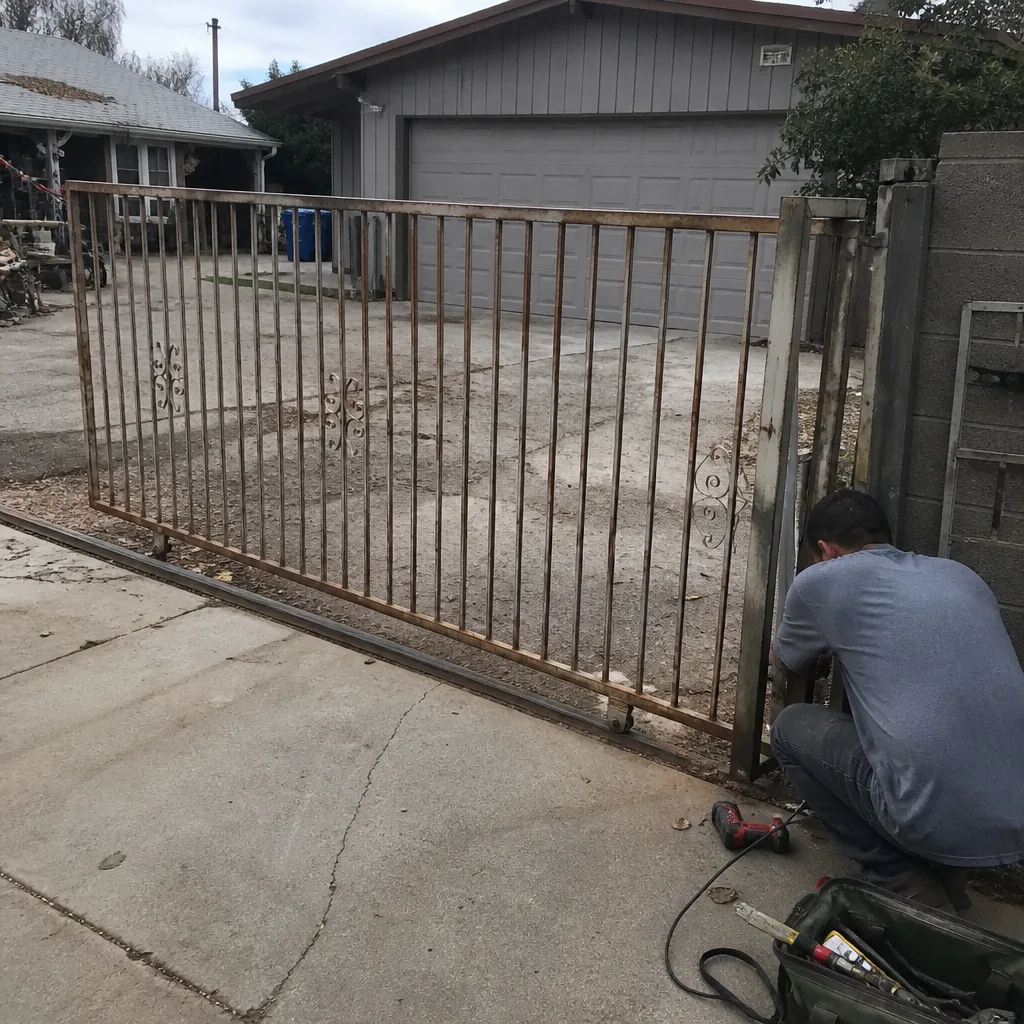 Before
 After
 Before
 After
 Before
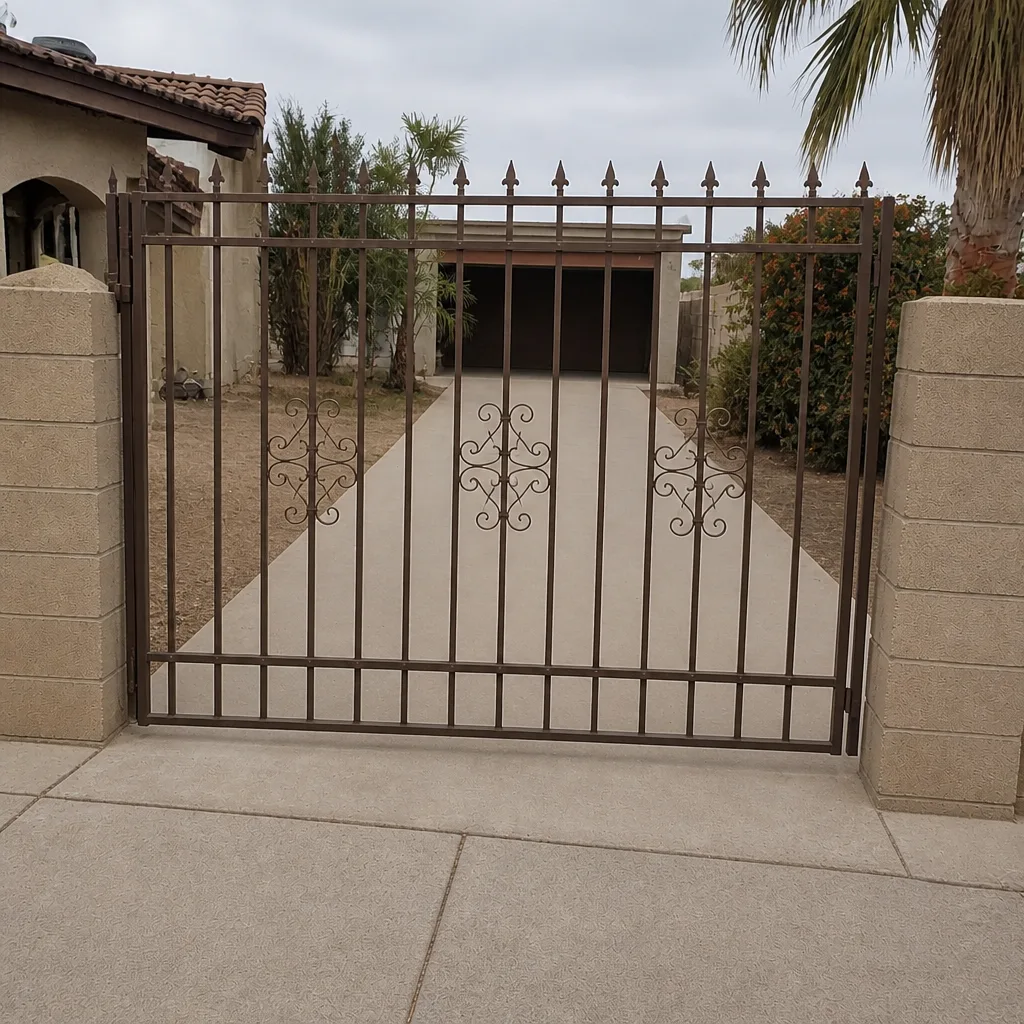 After
When to Call a Professional
Call a licensed gate professional when any of the following is true: the fault is electrical (gate won’t move, moves in one direction, reverses mid-travel, operator clicks without moving the gate); the repair touches the control board, the motor, the wiring, or a safety sensor; the gate is a heavy automated system on a residential or small commercial property; the post is visibly out of plumb or the footing is questionable; the operator is under warranty and the repair would require opening it; or you’ve attempted a mechanical repair and the symptom persists after the seasonal recheck. Each of these is a signal that the risk of the DIY attempt outweighs the savings, and in Glendale the ROC rules make the electrical cases a legal issue, not just a practical one. Gate Repair Glendale offers free estimates in Glendale – call (855) 632-1674. We answer 24/7. Fast dispatch from 7am to 7pm, Sunday through Friday.
Frequently Asked Questions
In Glendale, mechanical work on a manual or powered gate is generally homeowner-permissible, but any work on a 120V or 240V operator’s control board, wiring, motor, or safety sensors legally requires an Arizona ROC-licensed contractor. The dividing line is the electrical components. If your repair touches the operator’s electrical side, it’s a licensed job. Call (855) 632-1674 for a free estimate to confirm which category your repair falls into.
A quick test tells you: put the operator in manual release. If the gate moves freely by hand and the fault only appears when the operator is engaged, the fault is electrical. If the gate binds, drags, or sags even in manual, the fault is mechanical. Mixed symptoms (one direction only, intermittent, temperature-dependent) usually point electrical and warrant a licensed diagnostic. Gate Repair Glendale offers free estimates, and a short phone call will usually classify the fault before anyone comes out.
It depends on the manufacturer and on what the repair touched. LiftMaster, FAAC, Elite, and Mighty Mule operators include warranty language that can exclude coverage when the unit is serviced by unlicensed parties, particularly on the control board and motor. Opening the enclosure to check a battery or adjust a limit switch is one thing; replacing a factory component or altering internal wiring is another. If your operator is still under warranty, check the terms before you touch it. Call (855) 632-1674 for a free estimate that keeps the warranty intact.
Glendale’s combination of caliche soil and summer heat changes the failure modes. Caliche can shift or crack gate posts even when the surface looks stable, throwing off latch, hinge, and limit positions. Heat expands metal gate frames, chains, and the operator’s internal components, causing limit settings and chain tension to drift seasonally. A repair that works in mild weather may need adjustment by July. A professional visit accounts for both from the start. Call (855) 632-1674 for a free on-site estimate in Glendale.
Control board work on a 120V operator is the repair most likely to go wrong, and it’s also the one that clearly requires an Arizona ROC-licensed contractor. Symptoms include a gate that clicks without moving, one that stops partway regardless of operator, or one that reverses unexpectedly. These point at the board, its wiring, or its safety input, and the risk of an unlicensed repair is both injury and warranty loss. Gate Repair Glendale services all nine of the widely-installed brands including LiftMaster, FAAC, BFT, Elite, and Mighty Mule. Call (855) 632-1674 for a free estimate.
Gate Repair Glendale offers free estimates, and the price for any repair is set per job by the written estimate before any work starts. That means no surprise invoice after the visit; the number you agree to up front is the number you pay. If the diagnosis rules out a professional repair, you’ll know that before you commit. Call (855) 632-1674. We answer 24/7, with fast dispatch from 7am to 7pm, Sunday through Friday.
The Bottom Line
The DIY vs professional question comes down to three filters: is the repair mechanical or electrical, does it touch the operator or the wiring, and does the operator run on line voltage. Mechanical repairs on manual gates are usually in your scope. Anything involving the control board, the motor, the wiring, or a 120V safety system is ROC-licensed territory in Glendale, and it isn’t a judgment call about skill – it’s a legal line, a warranty line, and an insurance line all at once. If your gate is one of the nine brands a generalist may refuse to touch, a dedicated gate specialist is the safer resource. Call (855) 632-1674. We answer 24/7. Fast dispatch from 7am to 7pm, Sunday through Friday.
Written by the team at Gate Repair Glendale.